
Every provider key tracked as a governed asset with a stable AKO UID, encrypted at rest with AES-256-GCM, and never returned in API responses.
ProductComing soonSystem of record for AI credentials

Every AI credential your company holds — inventoried, owned, and auditable.
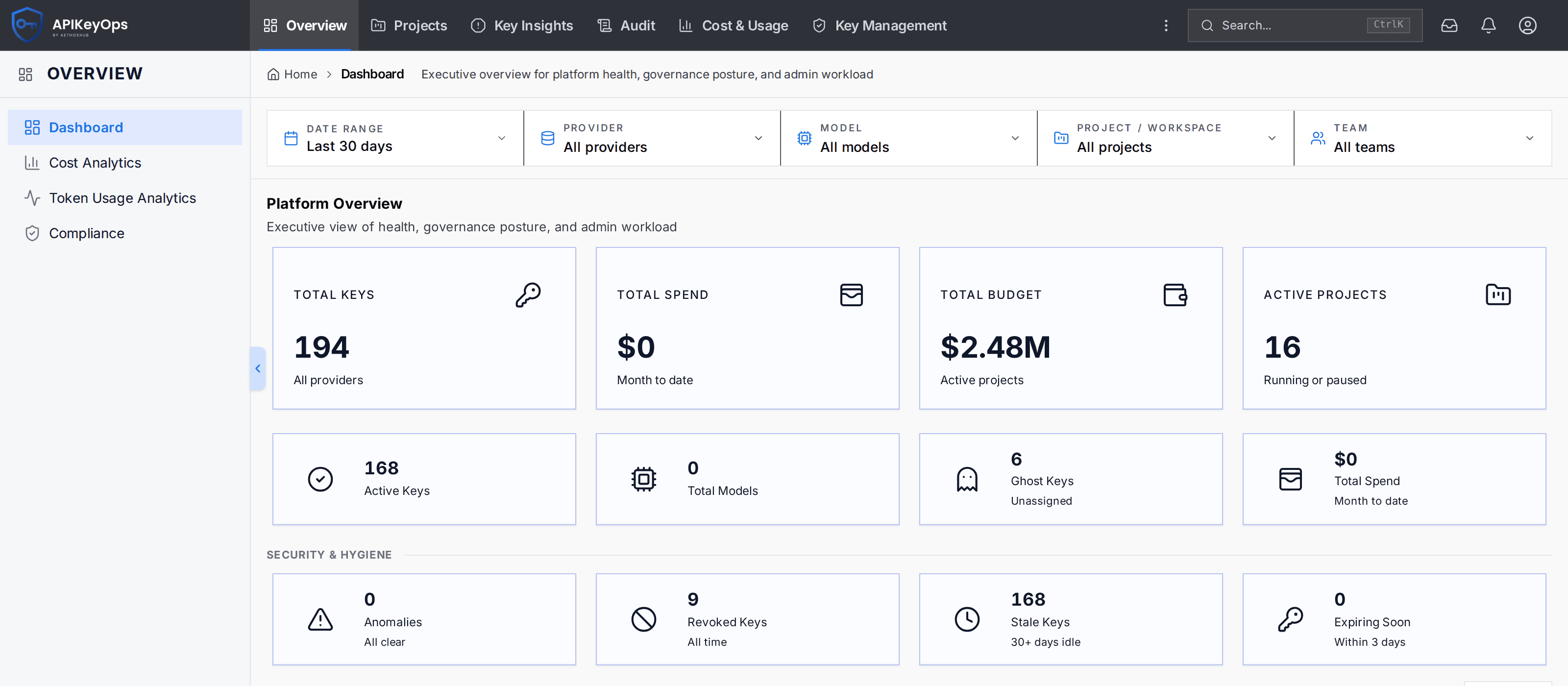
APIKeyOps is in active development and coming soon. It is being built as the system of record for provider API keys, connecting credential inventory, ownership, spend, rotation and expiry policy, and an audit trail behind every action.
app.apikeyops.com
Multi-providerRole-based accessAudit-ready evidence
Capabilities
Govern the keys behind your AI estate.
Provider API keys are production credentials with budgets attached. APIKeyOps treats them that way — inventoried, owned, rotated, and accounted for.
Provision new keys through the provider’s own admin API, register existing ones, revoke and replace with full history — and delegate keys, projects, and teams with role-based control.
Surface ghost keys nobody owns, stale keys idle for 30+ days, orphaned and expiring credentials, and usage anomalies — before an auditor or an attacker finds them.
Spend and token consumption attributed to the teams, projects, and budgets responsible — with per-provider reports for OpenAI, Anthropic, Gemini, and more.
Project budgets with spend tracking, organizational policies for rotation and expiry, and alert rules that notify owners before limits are breached.
Every security-relevant event recorded against the key’s stable identifier — exportable, evidence-ready trails for SOC 2 and ISO 27001.
How it works
From scattered keys to a governed registry.
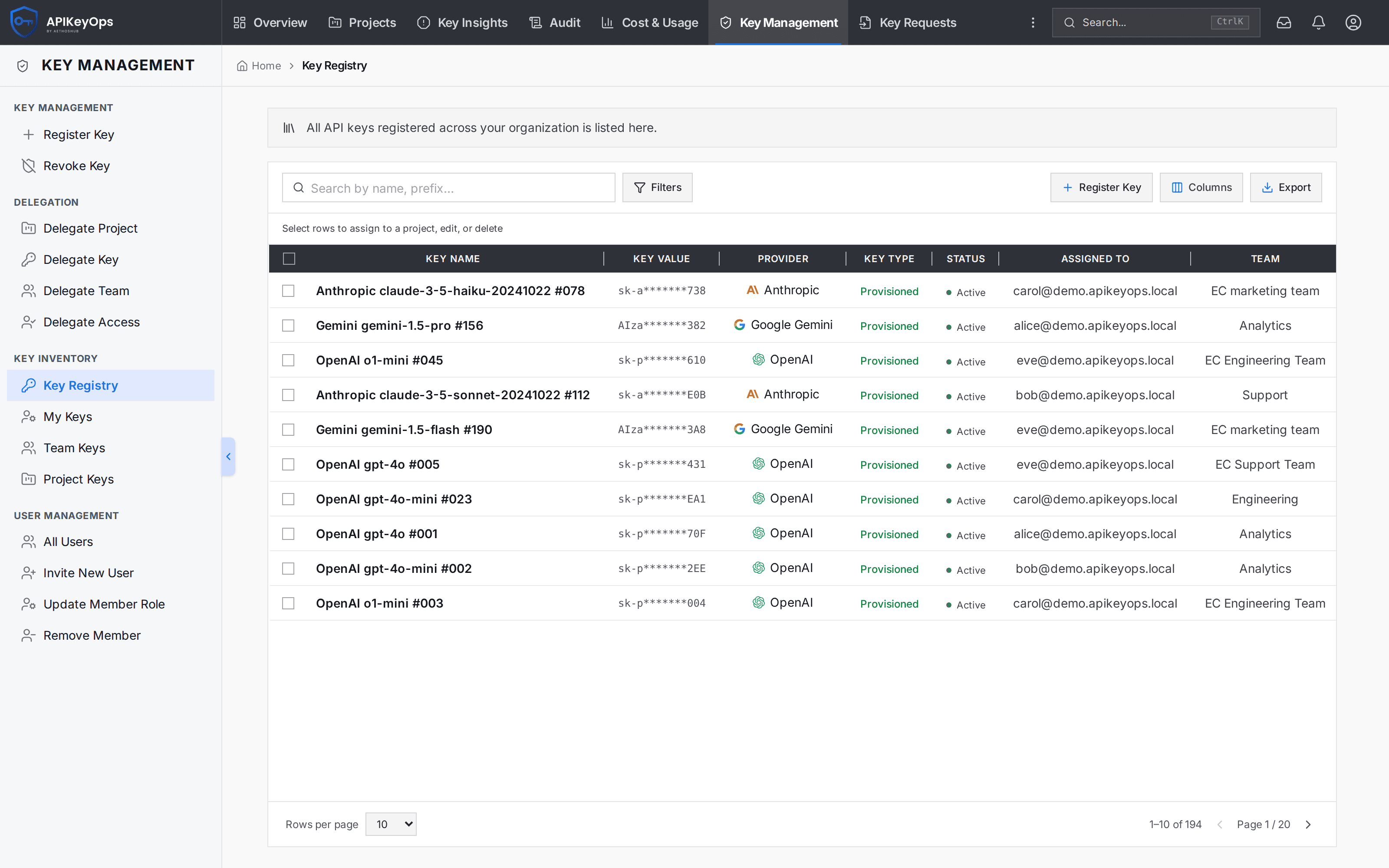
Register the keys your teams already use and provision new ones under governance. Each key gets an owner, a team, a project, and a stable audit identifier.
Delegate keys, projects, and teams with role-based access. Attach budgets and policies so every dollar of AI spend has someone accountable for it.
Rotation schedules, expiry alerts, and anomaly detection keep hygiene continuous — and the audit vault turns it into evidence your auditors accept.
Key Registry — every key, one governed inventory
Frequently Asked Questions
Questions teams ask before adopting.
How APIKeyOps turns scattered provider credentials into a governed, auditable inventory.
What is APIKeyOps?
APIKeyOps is an AI provider credential governance product in development and coming soon. It is being built to inventory the OpenAI, Anthropic, Gemini, and other provider keys a company uses, assign ownership and business context, track spend per key, and apply rotation and expiry policy with an audit trail.
How does it find keys we have lost track of?
Existing keys are registered into the inventory and new ones are provisioned under governance through the provider's own admin API. Risk discovery then surfaces ghost keys nobody owns, stale keys idle for 30 or more days, orphaned and expiring credentials, and usage anomalies — before an auditor or an attacker finds them.
Are the API keys themselves stored securely?
Yes. Every key is tracked as a governed asset with a stable identifier, encrypted at rest with AES-256-GCM, and never returned in API responses. Delegation of keys, projects, and teams is controlled with role-based access.
Can we attribute AI spend to teams and projects?
Yes. Spend and token consumption are attributed to the teams, projects, and budgets responsible, with per-provider reports. Project budgets track spend against limits, and alert rules notify owners before limits are breached.
How does APIKeyOps support SOC 2 and ISO 27001 audits?
Every security-relevant event — registration, delegation, rotation, revocation, policy changes — is recorded against the key's stable identifier in an audit vault. The trails are exportable and evidence-ready for SOC 2 and ISO 27001 reviews.
How is APIKeyOps different from Agent Access Manager?
APIKeyOps is being developed to govern provider credentials themselves: inventory, ownership, lifecycle, and spend accountability. Agent Access Manager is the available runtime product: it sits in the request path as a self-hosted AI gateway, issuing virtual keys and enforcing guardrails, budgets, and rate limits on every call.
Know every key. Own every dollar of AI spend.
APIKeyOps is in active development. Join the early-access list to share your requirements and be contacted when development previews and release information are available.
Preview access is limited while the product is in development.